
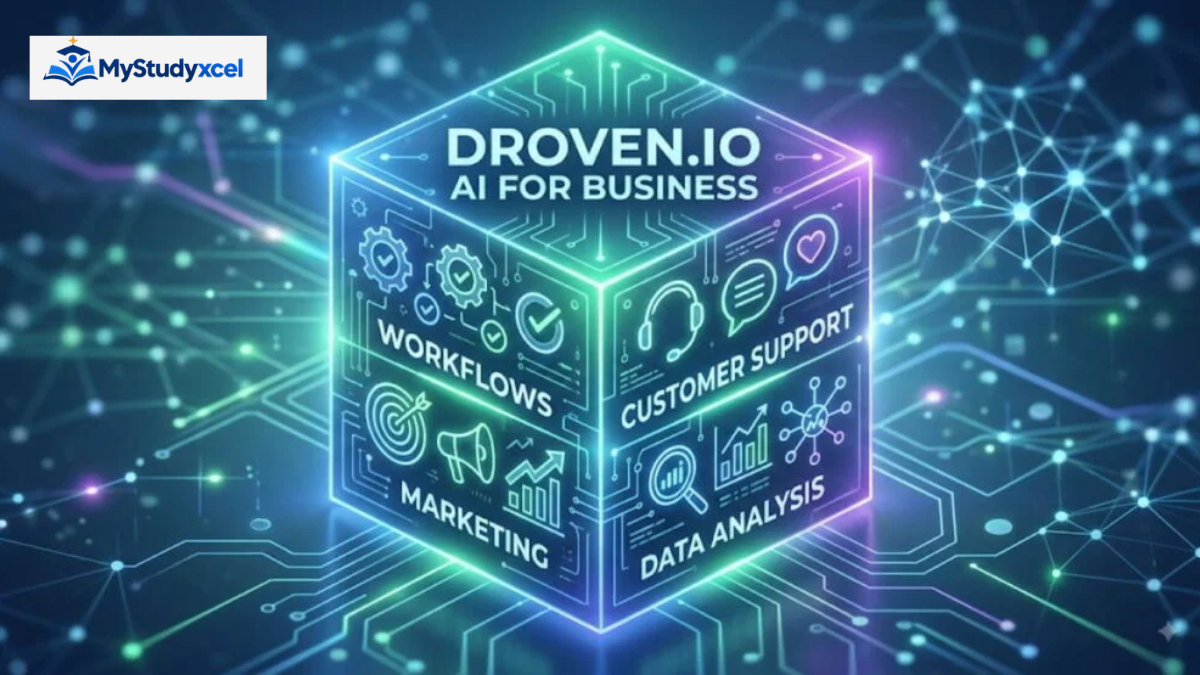
Droven.io AI for Business: A Practical Guide for Companies Exploring AI
droven.io ai for business AI tools are becoming much easier for small businesses to use. You no longer need a large IT team or a developer sitting beside you all day to automate parts of your work. The harder part is choosing a tool that actually fits the way your business operates droven.io ai for business.
That is where platforms such as Droven.io AI for business can be worth investigating.
If you are considering Droven.io for your company, I would not start with the question, “How much AI can this tool add?” I would start with a simpler question:
Which repetitive business task do I want to make easier?
That small change in thinking can save a lot of time and money.
For example, a small online store might need help organizing customer inquiries. A marketing agency may spend hours preparing routine content. A service business may want a faster way to handle internal information or repetitive administrative work. AI can be useful in all of these situations, but only when it is connected to a real business problem droven.io ai for business.
What is Droven.io AI for business?
Droven.io is positioned as an AI-focused platform for business use. Before adopting any AI service, however, it is important to check the provider’s current website for the exact features, pricing, integrations, data policies, and supported workflows because these can change over time droven.io ai for business.
Rather than treating an AI platform as a magic replacement for employees, think of it as a productivity layer droven.io ai for business.
The useful question is not:
“Can AI run my business?”
It is:
“Can AI reduce the amount of manual work my team has to do?”
That distinction matters.
A business owner might use an AI platform to assist with repetitive research, drafting, organization, customer communication, documentation, or other routine processes. A human should still review important information, especially when the output affects customers, finances, contracts, hiring, or compliance droven.io ai for business.
Where AI can actually help a business
One mistake I see businesses make with AI is trying to automate everything at once.
That usually creates more work.
A better approach is to find tasks with three characteristics:
- They happen frequently.
- They follow a fairly predictable process.
- A person spends unnecessary time doing them.
Imagine a company receives 50 customer questions every day.
If many questions are variations of:
- “Where is my order?”
- “What are your opening hours?”
- “How do I change my subscription?”
- “Can I return this product?”
then AI assistance may be useful.
But if the business sells expensive financial products and customers ask highly personal questions, blindly automating responses would be a poor choice.
AI works best when the boundaries are clear.
A realistic example: a small online business

Suppose you operate a small Shopify store with three employees.
One employee spends part of every morning going through customer messages, copying information into spreadsheets, writing similar replies, and forwarding complicated issues to the owner.
Instead of asking AI to “handle customer support,” break the process into smaller steps.
Step 1: Identify repetitive questions
Look through the previous 100–200 support messages.
Create a simple list of recurring questions.
You might discover that a large portion of the messages involve delivery times, returns, product availability, and order changes.
Step 2: Create approved answers
Write accurate answers based on your actual store policies.
This is important.
Don’t let an AI system invent return periods or shipping promises.
Give it approved information instead.
Step 3: Test AI-assisted drafts
Have the AI prepare suggested responses while an employee reviews them.
For the first few weeks, treat the system as an assistant rather than an autonomous customer-service agent droven.io ai for business.
Step 4: Track the results
Don’t measure success by how impressive the AI sounds.
Measure things such as:
- Average response time
- Number of messages handled per employee
- Customer complaints
- Incorrect answers
- Time spent correcting AI responses
If your employee previously spent three hours each morning handling repetitive messages and the new workflow reduces that to 90 minutes without hurting customer satisfaction, you have a measurable improvement droven.io ai for business.
That’s much more useful than simply saying, “We implemented AI.”
AI for marketing teams
Marketing is another area where AI can reduce repetitive work.
A small marketing team might use AI assistance for:
- First drafts of blog posts
- Social media ideas
- Content briefs
- Product descriptions
- Email variations
- Research notes
- Meeting summaries
- FAQ creation
However, there is an important difference between AI-generated content and good marketing content.
A generic article filled with keywords is unlikely to be valuable simply because AI wrote it quickly.
For example, imagine a company selling accounting software.
An AI tool can produce an article titled “10 Benefits of Accounting Software” in seconds.
But a better workflow would be to give the AI real information from the business:
- Common customer questions
- Support conversations
- Product documentation
- Industry terminology
- Actual customer objections
- Product limitations
The resulting draft can then be edited by someone who understands the customers.
That human editing is often where the useful detail comes from.
AI for internal business documents
Another practical use is organizing internal knowledge.
Many small businesses have important information scattered across:
- Google Drive
- Microsoft Word
- PDFs
- Excel spreadsheets
- Slack conversations
- Notion
- Project-management tools
Employees often waste time looking for information that already exists.
An AI workflow can potentially help employees locate or summarize information more quickly, depending on the platform’s supported integrations droven.io ai for business.
For example, imagine a sales employee asks:
“What’s our standard onboarding process for customers on the professional plan?”
Instead of searching through five folders, the employee could use an approved internal AI workflow to find the relevant documentation droven.io ai for business.
There is one major warning here: access control matters.
Business information should not automatically be uploaded to an AI service just because doing so is convenient droven.io ai for business.
Before connecting company documents, check:
- Where the data is stored.
- Whether customer information is used for model training.
- Who can access the information.
- Whether the provider offers deletion controls.
- What security measures are available.
- Whether the service meets your company’s legal or regulatory requirements.
For sensitive business information, this review should happen before deployment, not after a problem occurs.
Using AI on everyday devices
One advantage of modern AI services is that businesses don’t necessarily need expensive hardware droven.io ai for business.
A typical setup could involve:
- A Windows laptop for administration
- A MacBook for creative work
- An Android or iPhone for checking tasks while away from the office
- Google Chrome or Microsoft Edge
- Google Workspace or Microsoft 365
- Slack or Microsoft Teams
- Google Drive, Dropbox, or another document platform
The exact compatibility depends on the AI service and its current integrations, so check Droven.io’s current documentation before purchasing a plan specifically for one of these workflows.
You should also test the experience on the devices your employees actually use.
A workflow that looks excellent on a desktop computer may be frustrating if your sales team mainly works from mobile phones droven.io ai for business.
A simple way to test Droven.io before committing
If you are considering Droven.io for a business, don’t begin by moving your entire workflow.
Run a small test.
Day 1: Choose one task
Pick something repetitive and low-risk.
For example:
“Turn our weekly meeting notes into a structured list of action items.”
Don’t choose something critical such as processing payroll.
Day 2: Collect examples
Take five to ten previous examples of the task.
Keep personal or confidential information out of the test unless you have already confirmed that the platform’s data handling is appropriate droven.io ai for business.
Day 3: Create your workflow
Define exactly what you want the AI to produce.
Instead of:
“Summarize this meeting.”
Try:
“Create four sections: decisions made, action items, owner, and deadline. If a deadline was not mentioned, write ‘Not specified.’ Do not invent information.”
The second instruction gives the system much less room to guess.
Day 4: Compare the results
Have a person compare the AI output with the original documents.
Look for:
- Missing information
- Incorrect statements
- Made-up details
- Poor formatting
- Unclear action items
Day 5: Calculate the time saved
Suppose the old process takes 45 minutes and the new process takes 15 minutes.
That’s a 30-minute saving.
If the task happens five times per week, that’s 2.5 hours per week.
Now you can make a business decision based on actual results rather than an AI sales pitch.
Common mistakes businesses make
Mistake 1: Automating a bad process
AI does not automatically fix a confusing workflow.
If employees don’t know who approves customer refunds, adding AI won’t solve the underlying problem.
Document the process first.
Mistake 2: Trusting AI without checking it
AI systems can produce convincing but incorrect information.
This is particularly dangerous for:
- Legal information
- Financial decisions
- Medical information
- Contracts
- Customer account information
- Technical instructions
Use human review where mistakes could have serious consequences.
Mistake 3: Feeding sensitive information into the wrong system
Before uploading customer lists, employee records, contracts, passwords, financial documents, or confidential business plans, understand the platform’s privacy and security terms.
Never paste passwords, API keys, or private credentials into an AI prompt.
Mistake 4: Measuring activity instead of results
A company might proudly announce that employees generated 2,000 AI-assisted documents.
That number means very little.
A better question is whether the company:
- Saved employee hours
- Reduced errors
- Responded to customers faster
- Improved documentation
- Increased completed sales
- Reduced repetitive administrative work
Business value should be measured in outcomes.
Mistake 5: Assuming AI output needs no editing
Even excellent AI tools can produce writing that sounds generic.
If your customers can tell that every email was produced from the same template, your brand can quickly lose personality.
Use AI for speed, but keep human judgment in the process.
Is Droven.io worth using for your business?
There isn’t a universal answer.
For a small company with a few repetitive workflows, an AI platform could be useful if it saves enough employee time to justify its cost.
For a business with complicated processes, sensitive information, or strict compliance requirements, the decision requires more careful testing.
I would compare Droven.io against the tools your team already uses rather than evaluating it in isolation.
For example, if your employees already rely heavily on Google Workspace, Microsoft 365, Slack, or a CRM, check whether your existing software already provides the AI capabilities you need.
Adding another subscription doesn’t automatically improve productivity.
Sometimes the best AI solution is the feature you already pay for.
Questions to ask before paying
Before choosing an AI business platform, I would ask these questions:
What exactly am I automating?
If you can’t answer this clearly, you’re probably not ready to buy.
Can I test it with a small workflow first?
A trial or limited pilot is valuable.
What happens to my data?
Read the privacy and security documentation rather than relying only on marketing language.
Does it integrate with the tools my employees already use?
An AI tool that requires constant copying and pasting may save less time than expected.
Can humans review the output?
For many business processes, this should be part of the workflow.
How will I measure success?
Choose one or two numbers before starting the experiment.
My preferred approach to business AI
I would start small.
Pick one annoying task that employees repeat every week. Document how it is currently done. Test AI against the existing process. Keep the human review stage in place. Measure the time saved and the number of errors.
If the results are good, expand gradually.
That approach is less exciting than promising to “transform the entire business with AI,” but it is much more practical.
For Droven.io specifically, verify the platform’s current features, pricing, integrations, privacy terms, and supported use cases directly before making a purchasing decision. AI products change quickly, and information that was accurate several months ago may no longer describe the current service.
The best AI tool for a business isn’t necessarily the one with the longest feature list. It is the one that fits an existing workflow, saves meaningful time, protects important information, and produces results that a human can trust and review.
If Droven.io can do those things for a particular workflow in your company, it may be worth testing. The smartest way to find out is not to automate everything at once—it is to run one small, measurable experiment and let the results make the decision.
Also Read: techtrendery com



One Comment